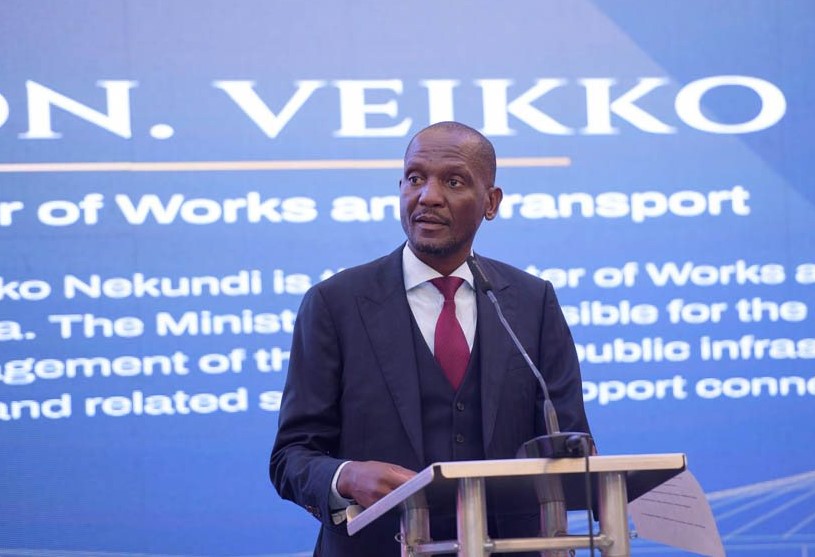
Works and Transport Minister Veikko Nekundi questions engineering project costs, raises concerns over graduate registration delays and calls for greater accountability in infrastructure spending and challenged Namibia’s engineering profession to reconsider the cost of infrastructure projects delivered to Government.
Speaking at the inaugural 2026 Namibia Engineering Excellence Awards, held under the theme Engineering and National Development, the minister warned that the country can no longer afford exorbitant consultancy fees while facing growing demands for roads, water, energy and other essential infrastructure.
Nekundi raised concerns over the high costs associated with engineering consultancy services, citing road projects where the quoted costs had reached millions of dollars despite relatively short distances.
He revealed that on Thursday, 12 November 2026, he was presented with estimates of more than N$12 million for a road project covering just five kilometres and N$16 million for a 10-kilometre road project.
The minister questioned whether such costs were sustainable for Government, given the country’s limited financial resources and competing development priorities.
“Therefore, our engineering professionals should revisit their costing to their government. We simply can no longer afford consultants in the engineering profession,” Nekundi said.
His remarks place the spotlight on engineering consultancy costs and the need for greater value for money in the planning, design and implementation of public infrastructure projects.
The minister also raised concerns about the difficulties experienced by young engineering graduates, particularly those from previously disadvantaged backgrounds, in obtaining professional registration through the Engineering Council of Namibia (ECN). He said some graduates had remained unable to register for between five and 10 years after completing their studies, describing the situation as a serious concern requiring urgent attention.
Nekundi warned that if the registration challenges were not addressed, Government might have no option but to consider amendments to the Engineering Council of Namibia Act. He stressed that professional development and access to registration must receive attention to ensure that Namibia develops and retains the engineering skills needed to support its national development agenda.
Beyond the immediate concerns surrounding consultancy costs and professional registration, Nekundi emphasised the central role of engineering across virtually every sector of the economy, including energy, mining, manufacturing, agriculture, water, telecommunications, housing, healthcare, transport and environmental management.
He said Namibia faced three simultaneous responsibilities: maintaining and optimising existing infrastructure, developing new infrastructure to meet growing national needs, and preparing engineering systems and professional capabilities for rapidly changing technologies.
These responsibilities must be achieved despite limited financial resources, competing national priorities and increasing demands for public services.
Nekundi pointed to Namibia’s approximately 50 000-kilometre national road network as an example of the country’s infrastructure maintenance challenges. He noted that sections of the network had exceeded their intended design life, increasing maintenance requirements.
He said infrastructure represented substantial national wealth accumulated through decades of public and private investment, but that its value could not be maintained without proper management, regular maintenance and technological upgrades.
The Ministry’s Strategic Plan for 2025/26 to 2029/30, he added, places emphasis on effective asset management, institutional performance, regulatory compliance and improved service delivery.
Nekundi congratulated the Namibia Engineering Excellence Awards Task Force and its engineering partners for establishing the national platform, saying engineering development extended beyond the responsibility of a single ministry or institution.
He called on engineering professionals and their partners to preserve existing infrastructure wisely, build responsibly, innovate purposefully and work together to ensure that engineering continues to serve Namibia’s national development.
Namibia needs engineering excellence, but it must also come with affordability, accountability, professional development and measurable value for public money.
By Rudi Bowe