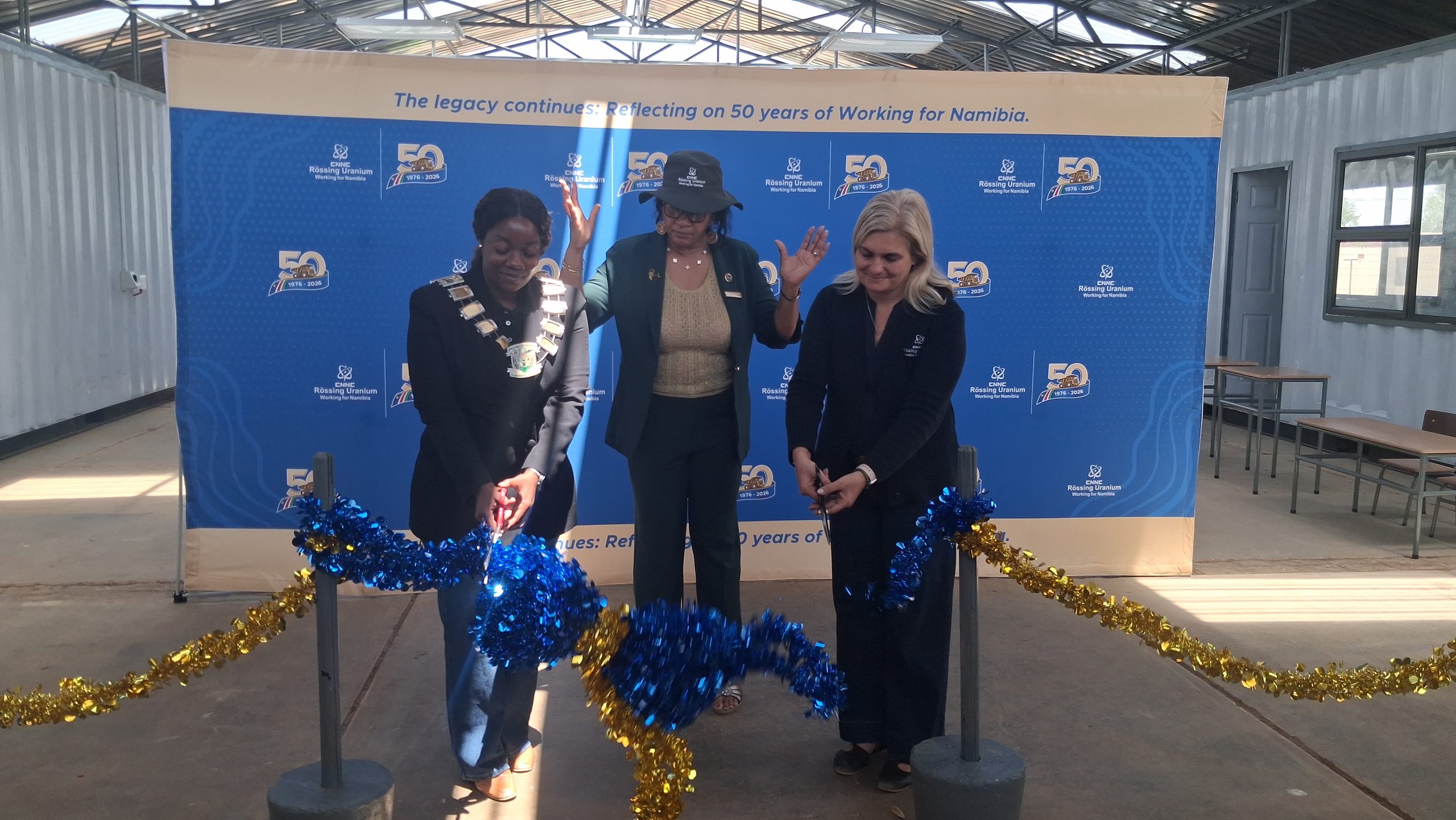
Young Namibians in Arandis and the wider Erongo Region have a new opportunity to turn their technical skills into viable businesses following the handover of a Youth Incubation Centre to the Namibian Institute of Mining and Technology (NIMT) by Rössing Uranium last Friday.
The centre, established through an investment of N$250 000 by Rössing Uranium, aims to bridge the gap between technical and vocational training, entrepreneurship and economic participation by providing young artisans with access to workspace, equipment, industry expertise and mentorship. Officially inaugurated by Erongo Governor Dr Natalia /Goagoses, the facility is intended to help NIMT-trained artisans gain practical experience, develop business ideas, establish their own enterprises and access opportunities within the job market.
Speaking at the handover ceremony, Rössing Uranium’s General Manager for Human Capital, Safety and Sustainability, Liezl Davies, said the initiative reflected the company’s belief that sustainable community development must involve communities rather than simply be delivered to them. “We understand that sustainable community development cannot simply be something that a corporate does for people. It must increasingly be something that we do with people,” Davies said. She explained that the project was guided by Rössing Uranium’s Asset-Based Community Development approach, which recognises and builds on skills and resources already available within communities.
As part of this approach, unemployed NIMT-trained artisans were involved in constructing the centre, allowing them to apply their technical knowledge, gain practical experience and earn an income while contributing to the development of the facility. Davies said development should not only create infrastructure but should also generate economic opportunities during the construction process. She encouraged young people to take ownership of the centre, describing them as its greatest asset. “This centre is an asset, but you are the greater asset,” she said, adding that the ultimate aim should be to create employers rather than employees. NIMT director Ralph Bussel described the completion of the project as a dream realised, highlighting the creativity and determination that went into bringing the facility to life despite financial and logistical challenges. He explained that the initial N$250 000 investment was not sufficient to cover all the requirements, prompting NIMT to find cost-effective ways to complete the project.
The institution opted to use converted shipping containers to establish the facility, while F.P. du Toit Transport provided additional support with transportation. Bussel also shared how NIMT staff used their own ingenuity to move a 12-metre container into position by manufacturing four steel wheels from available materials, avoiding the need to hire expensive lifting equipment. He used the experience to encourage young artisans to think creatively and make the most of the resources available to them. “You don’t have to have a lot of money, but you can make a lot of money,” he said, urging young people to wake up from their dreams and turn their ideas into reality. Delivering the keynote address, /Goagoses said the centre represented more than the completion of a physical facility, describing it as an investment in young people’s potential and their contribution to the economic development of the Erongo Region.
She noted that the region’s mining, fishing, tourism, manufacturing and logistics industries offer opportunities for employment, skills development and enterprise growth, but stressed that youth unemployment remains a challenge requiring collective action. /Goagoses encouraged young artisans to identify opportunities within the mining and industrial sectors, particularly in technical services, maintenance, fabrication and specialised products and services. She said the region needed locally owned businesses capable of participating in industry supply chains rather than young people remaining on the margins of economic development.

/Goagoses further emphasised that technical qualifications alone were not enough, saying young people also needed entrepreneurial skills, mentorship and an understanding of market requirements to turn their knowledge into sustainable businesses. She called on Rössing Uranium, NIMT and other stakeholders to ensure that the centre becomes an active space for learning, innovation, mentorship and business development. “The success of this centre will not be measured by its infrastructure alone. It will be measured by the businesses established, the employment opportunities created, the number of young people supported, and the livelihoods improved,” she said. /Goagoses also stressed that addressing youth unemployment required cooperation between government, the private sector, training institutions and local authorities.
While government provides policy direction, she said, institutions such as NIMT equip young people with technical skills, while the private sector contributes investment, expertise and access to economic opportunities. The handover was supported by NIMT and F.P. du Toit Transport, with Rössing Uranium acknowledging the contributions of the artisans who helped construct the facility.
The initiative also supports Namibia’s Sixth National Development Plan (NDP6) and the United Nations Sustainable Development Goals, particularly those relating to quality education, decent work and economic growth, and partnerships. As Rössing Uranium marks 50 years of operations in Namibia, the company said the centre reflects its continued commitment to skills development, entrepreneurship and sustainable livelihoods.
By Sharlien Tjambari