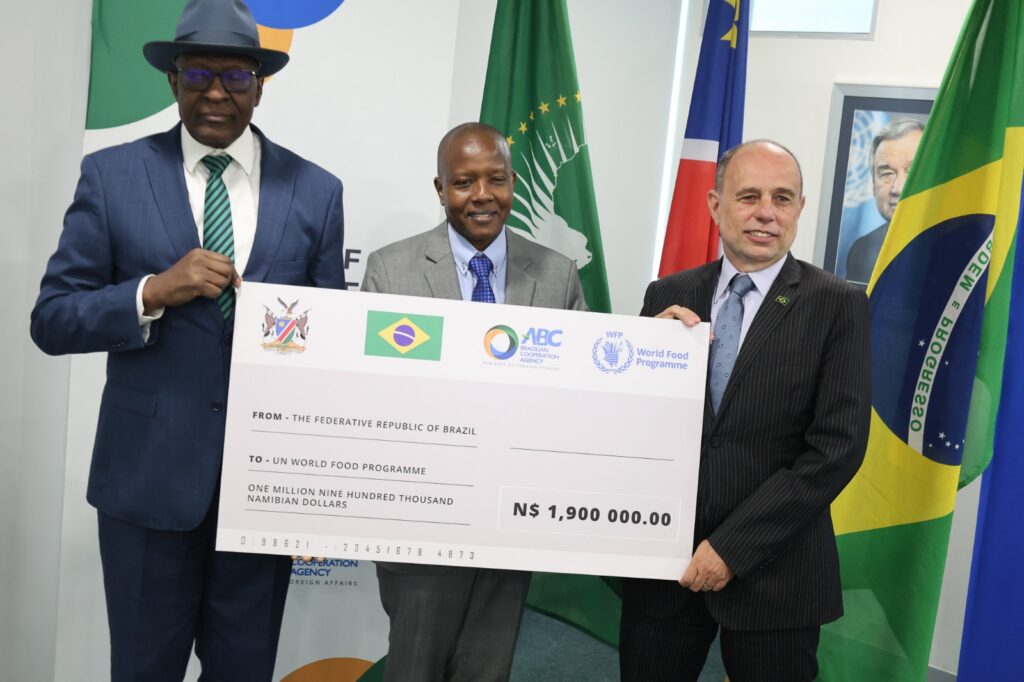
The Government of Brazil has reaffirmed its commitment to strengthening food security and sustainable agriculture in Namibia by contributing USD 120,000 (approximately N$1.97 million) to the United Nations World Food Programme (WFP).
The funding, announced during a handover ceremony on 16 July 2026, will support community-based agricultural projects aimed at improving food security, nutrition and resilient food systems in five regions, benefiting more than 1,000 people.
The initiative focuses on the Otjozondjupa, Omaheke, Hardap, Kunene and Ohangwena regions, where community production hubs established at schools and health centres combine horticulture and poultry farming. These hubs supply fresh vegetables and eggs to school feeding programmes, soup kitchens serving pregnant and breastfeeding women, and vulnerable households.
The programme is rooted in South-South cooperation, with Brazil sharing practical expertise to help communities move from dependence on food aid to sustainable agricultural production and self-reliance.
Speaking at the handover ceremony, National Planning Commission (NPC) Director General, Ambassador Dr. Kaire Mbuende, said the impact of the partnership between Brazil, the Government of Namibia and WFP is already evident through increased agricultural production, improved household incomes and stronger food security across the country.
He noted that more than 300 smallholder farmers have benefited from the programme, receiving training in financial management, value addition, good agricultural practices and market access.
“Communities that once depended on food assistance are increasingly producing their own food and generating an income,” Mbuende said.
He described Brazil’s support, implemented through WFP, as an example of the value of South-South cooperation.
“Brazil’s contribution demonstrates the true value of South-South cooperation through the sharing of practical experience in family farming, food security systems and linking agricultural production with social programmes. These are lessons exchanged in mutual respect to address common development challenges,” he said.
UN Resident Coordinator Hopolang Phororo said the latest contribution reflects the importance of international partnerships and solidarity in advancing sustainable development.
Brazil’s Ambassador to Namibia, H.E. Pedro de Castro da Cunha e Menezes, said the partnership has evolved beyond humanitarian assistance.
“Brazil’s partnership with Namibia has evolved from humanitarian assistance to sharing practical experience that helps communities build their own resilient food systems. Our goal is not simply to provide resources, but to support people in becoming self-reliant through stronger agriculture, better nutrition and opportunities that create lasting food security for future generations,” he said.
James King’ori, Head of Office for WFP Namibia, said the funding will have both immediate and long-term benefits for vulnerable communities.
“This latest funding from Brazil extends well beyond immediate assistance in farming communities. It equips communities with the tools and opportunities to strengthen livelihoods, improve nutrition and build sustainable and resilient food systems so they are better able to withstand shocks such as drought,” King’ori said.
Acting WFP Country Director Tiwonge Machiwenyika said the programme supports Namibia’s national Zero Hunger agenda by improving household food and nutrition security while creating jobs, strengthening agricultural value chains and transforming rural livelihoods.
Brazil’s Ambassador Vivian Loss Sanmartin said South-South cooperation is designed to empower communities.
“The objective is to provide people with the tools to produce food, market their products and establish successful models that can be replicated elsewhere,” she said.
Over the past six years, Brazil has contributed more than N$3.5 million to WFP Namibia, supporting initiatives to combat malnutrition and advance the country’s Zero Hunger efforts.
The continued collaboration between Brazil, WFP and the Government of Namibia highlights the role of international partnerships in building resilient food systems, promoting sustainable agriculture and ensuring that vulnerable communities become self-sufficient through locally driven solutions.
By Rudi Bowe