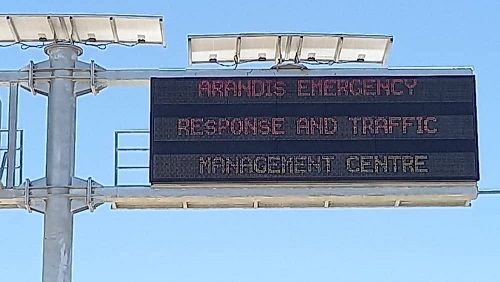
Motorists travelling between Swakopmund, Arandis and Usakos will increasingly have to watch their speed and driving behaviour as Government rolls out a high-tech surveillance network designed to detect reckless driving and help authorities intercept offenders in real time.
Works and Transport Minister Veikko Nekundi says cameras already operating along parts of the B2 will form part of a wider 140-kilometre digitally monitored corridor, managed from the N$60 million Arandis Emergency Response and Traffic Management Centre to monitor Swakopmund–Usakos corridor around the clock. The centre that will be inaugurated later this year, situated at the Arandis turn-off, is connected to emergency and law-enforcement agencies 24 hours a day.
Nekundi told Parliament that cameras covering the initial approximately 40km between Arandis and Swakopmund and Arandis and Usakos are already functional, while the remainder of the system is expected to be operational by the end of November. The cameras use Automated Number Plate Recognition, CCTV and vehicle-counting technology, while electronic message signs will warn motorists about hazards and changing road conditions. “If you drive recklessly, the control centre will immediately communicate with the nearest traffic officers in the direction you are travelling,” Nekundi said. He explained that a motorist driving dangerously towards Usakos could be identified after passing Arandis, with officers further along the route alerted and positioned to intercept the vehicle.

The rollout comes as authorities prepare for increased traffic during the festive season. Nekundi said the surveillance cameras will support the detection of negligent driving, road incidents and speed-related violations. A pilot programme involving the National Road Safety Council, Nampol, Roads Authority and local authorities will introduce type-approved enforcement cameras within the next three months.
The corridor carries heavy traffic, with the Karibib–Usakos section alone recording about 2 975 vehicles daily, including 935 heavy vehicles. Nekundi said the technology is intended to shift road safety from simply responding to crashes to detecting dangerous behaviour and intervening before tragedy strikes.
By Rudi Bowe