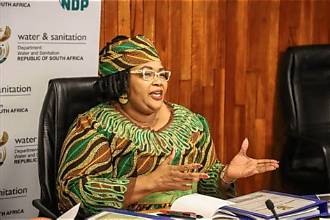
South African Sanitation Minister, Pemmy Majodina / Photo: Facebook
Namibia and South Africa must deepen cooperation in managing shared water resources and investing in water infrastructure as climate change and growing demand place increasing pressure on the region’s limited water supplies.
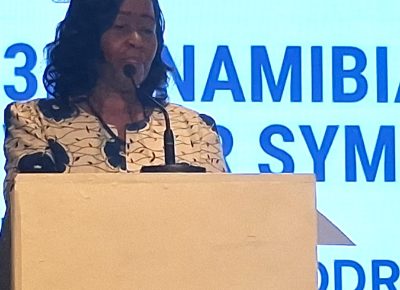
This was the message delivered by South African Minister of Water and Sanitation, Pemmy Majodina, during her keynote address at the Third Namibia Regional Water Symposium in Swakopmund on Tuesday last week.
Majodina said water challenges do not stop at national borders, making cooperation between neighbouring countries essential to securing reliable water supplies for communities and industries. “Namibia and South Africa share rivers. We share the Orange River. We share drought. We share climate,” she said. She stressed that neither country nor government could address the challenges alone, calling for stronger partnerships between governments, the private sector, scientists, traditional leaders, communities and regional institutions. Majodina also called on the private sector to play a greater role in financing water infrastructure, arguing that governments alone cannot close the funding gap required to modernise ageing systems. She highlighted the importance of innovation, including smart water meters to detect leaks, solar-powered boreholes for rural communities, wastewater reuse and rainwater harvesting. According to Majodina, between 35% and 45% of treated water across Southern Africa is lost before reaching households, largely because of leaking pipes and ageing infrastructure. She warned that climate change was further complicating water management through longer droughts, stronger floods and increasingly unpredictable rainfall patterns.

The Minister said the region must strengthen early warning systems, protect groundwater resources and invest in infrastructure capable of withstanding changing climate conditions. She also pointed to existing cooperation mechanisms, including the Permanent Water Commission, the Orange-Senqu River Commission and the Southern African Development Community (SADC), as important platforms for strengthening regional water management. Majodina concluded with a call for practical action, challenging both countries to ensure that no mother has to walk four kilometres to collect water by 2030. “Let us not wait for another conference. Let us start here, in this room, in this region, today,” she said.
Her address reinforced the importance of turning regional discussions into practical partnerships that improve access to water and strengthen resilience across Southern Africa.
By Sharlien Tjambari