Photo: Namport
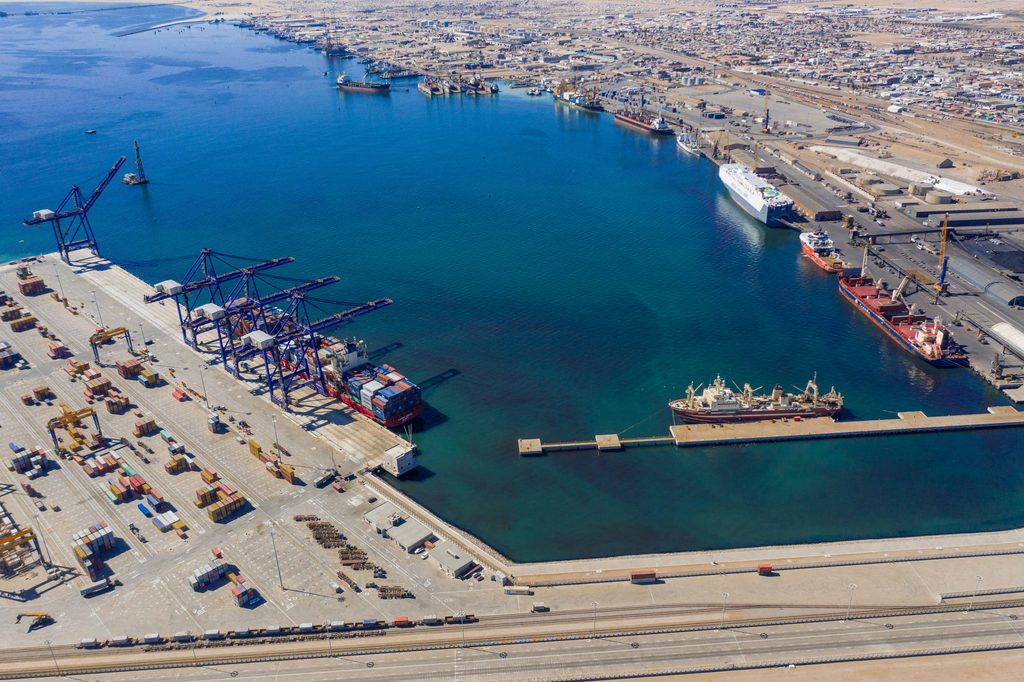
The Port of Walvis Bay was used as the first testing point for a new regional customs system aimed at making cross-border trade faster, safer and more efficient.
Botswana, Namibia and South Africa officially started the second phase of the Southern African Customs Union (SACU) Regional Authorised Economic Operator (AEO) Mutual Recognition Arrangement pilot on 18 August. The pilot will run until March 2027 and is being implemented by the Botswana Unified Revenue Service (BURS), Namibia Revenue Agency (NamRA) and South African Revenue Service (SARS). The aim is to test how accredited businesses can receive the same trusted-trader benefits across the SACU region. A first pilot phase was conducted between Eswatini, Lesotho and South Africa from January to March this year.
Walvis Bay First to Test System
The second phase was preceded by a series of operational tests at key border points. The first dry-run was held at the Port of Walvis Bay on 29 July, followed by exercises at the Mamuno and Buitepos border posts along the Trans-Kalahari Corridor on 31 July. Further tests were conducted between Botswana and South Africa at Tlokweng and Kopfontein on 3 and 4 August, and between Namibia and South Africa on 6 and 7 August. The exercises allowed revenue authorities, AEO experts, government agencies and the SACU Secretariat to test the systems and procedures before the official start of the pilot. They also allowed the authorities to observe how accredited traders are processed and identify practical improvements.
The AEO programme is designed for businesses that meet established standards for secure and reliable international trade. Under the regional arrangement, accredited traders will progressively receive benefits such as faster clearance and release of goods through risk-based processing. They could also face fewer routine inspections, while inspections that are required will receive priority.
The programme will also allow inspections to take place at an alternatively approved location where appropriate. Most importantly, a trader’s AEO status will be recognised across SACU member states. The system is expected to reduce delays at borders, improve supply chain security and make cross-border trade more efficient. It is also intended to improve cooperation between revenue authorities and other government agencies through better information sharing and coordinated risk management. SACU is encouraging eligible businesses across the region to participate in the AEO programme.
At the end of the first quarter of the 2026/27 financial year, SACU had 1 070 accredited AEOs. South Africa had the largest number with 1 006, followed by Eswatini with 33, Lesotho with 14, Namibia with 10 and Botswana with nine. The second pilot phase is intended to test the practical implementation of the signed SACU Mutual Recognition Arrangement under real operating conditions. Full implementation across all SACU member states is expected to begin in April 2027.
SACU said the pilot is an important step in its Customs Modernisation Programme and demonstrates the organisation’s commitment to secure, efficient and predictable cross-border trade across the region.
By Eileen van der Schyff