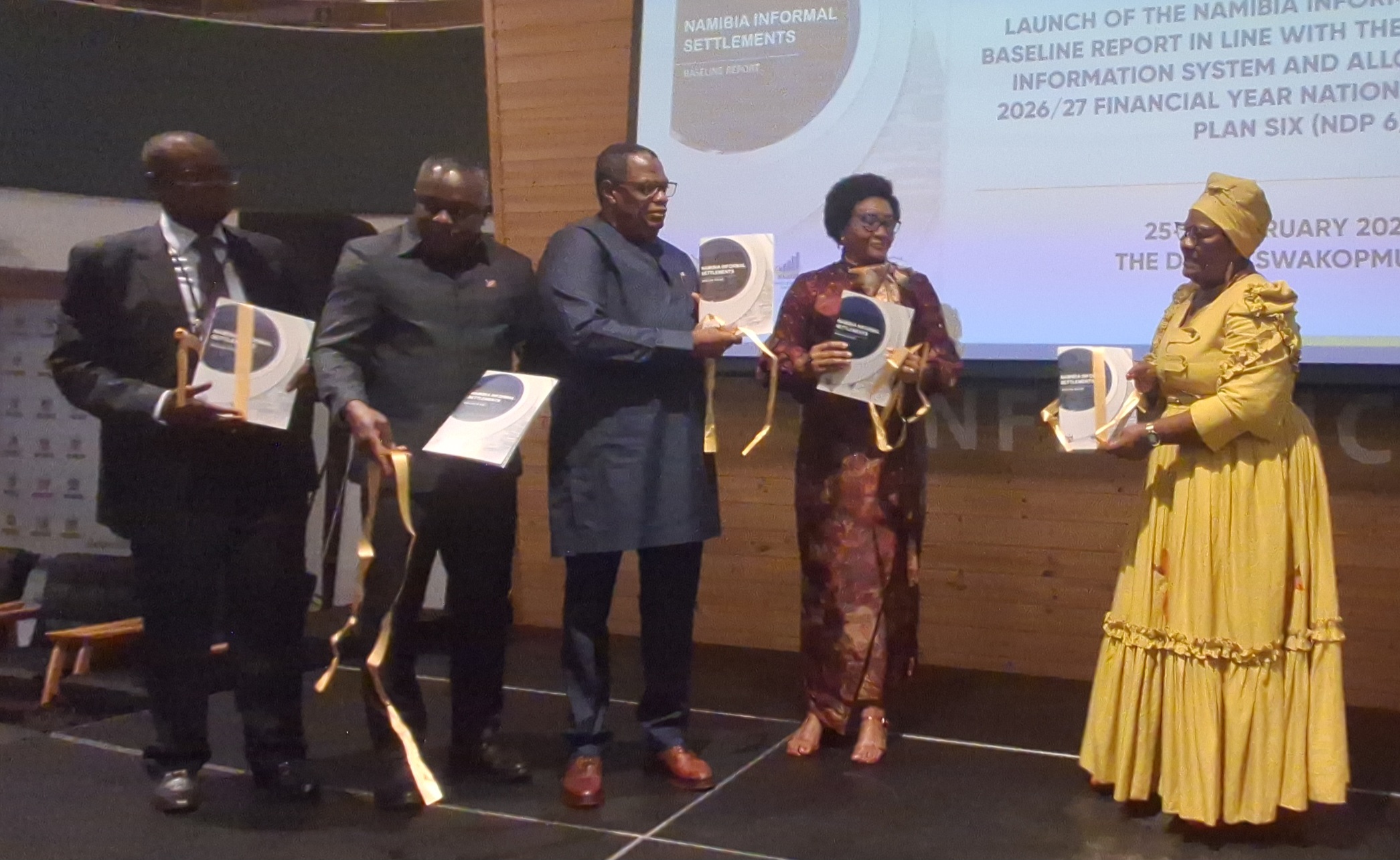
The Ministry of Urban and Rural Development has officially launched the Namibia Informal Settlements Baseline Report, describing it as a critical tool to guide land servicing, housing delivery, and the formalisation of informal settlements under the Sixth National Development Plan (NDP6).
The report was launched on Wednesday at The Dome in Swakopmund during a national workshop that also reviewed 2025/26 targets and began planning for the 2026/27 to 2028/29 financial years.
Erongo Governor Natalia /Goagoses said the report must translate into real change for people living in informal settlements. “What must be put into our minds are the Namibians inside that report, Namibians who are living in these informal settlements. Let us regard this exercise as a very serious matter,” she said. She urged stakeholders to ensure that the launch leads to tangible improvements. “After this report launch, we must start seeing the impact and the change in our communities. Housing represents dignity, security, and opportunity.” /Goagoses noted that according to the 2023 Population and Housing Census, Erongo recorded the highest rural-urban migration rate in the country, exceeding 90 percent.
“Urban areas are unable to accommodate as much as Namibians have the freedom to move where they want to move,” she said, adding that economic growth in mining, fishing, tourism and logistics continues to increase pressure on land delivery, infrastructure and housing provision. Delivering a statement on behalf of the Director General of the National Planning Commission, Ambassador Lineekela J. Mboti, CEO of the APRM in Namibia said land and housing delivery occupy a central place in NDP6, which covers 2025/26 to 2029/30 and serves as the final national development plan toward Vision 2030. By 2030, Namibia aims to increase serviced plots from 25 111 to 50 000 and houses constructed from 12 598 to 55 126, while reducing the pro-portion of households living in informal settlements from 28.7 percent to 14 percent. “The Namibia Informal Settlements Baseline Report being launched stands as a clear demonstration of the value of evidence-based planning and strong inter-in-stitutional cooperation,” Mboti said. He noted that the absence of standardised national data has historically limited effective planning and resource allocation. “With such quality data and statistics, the National Planning Commission will be better positioned to advocate for adequate resource allocation, strengthen monitoring and evaluation, and support timely and informed policy decisions,” he said. In a statement delivered on his behalf, Urban and Rural Development Minister Sankwasa James Sankwasa described the report as a “significant milestone” in understanding and transforming living conditions in informal settlements. According to the 2023 Census, 28.7 percent of Namibian households, equivalent to 217,068 households, live in informal dwellings or shacks. Of these, 40.2 percent (87,262 households) are located in urban areas. The Minister warned that rapid urbanisation is accelerating. “The urban population rose from 42.8 percent in 2011 to 50 percent in 2023, an increase of 7.2 percent over just 12 years,” the statement read, cautioning that without serious intervention, Namibia’s urban population could outnumber its current total population by 2050.

While welcoming the launch, the Minister acknowledged that the report had been due in May 2025. “We register our unhappiness for our failure to meet the deadline of May 2025 as set and required by Cabinet,” the statement noted. However, he stressed that the report is not an end in itself. “The real value of this report will be measured by how effectively its findings are translated into policy reforms, programme design, institutional coordination, and resource mobilisation for sustainable interventions.” Under the 2025/26 targets, the government reported progress that includes the formalisation of 36 informal settlements, the construction of 3 000 houses, the servicing of 10 000 plots, and the installation of 260 shared sanitation facilities. Sankwasa called on regional councils, local authorities, traditional leaders, civil society, the private sector, and development partners to use the report as a core planning tool. “Together, we can move from data to delivery, from policy to people, and most importantly from planning to giving our people the dignity they deserve,” the statement concluded.
By Sharlien Tjambari