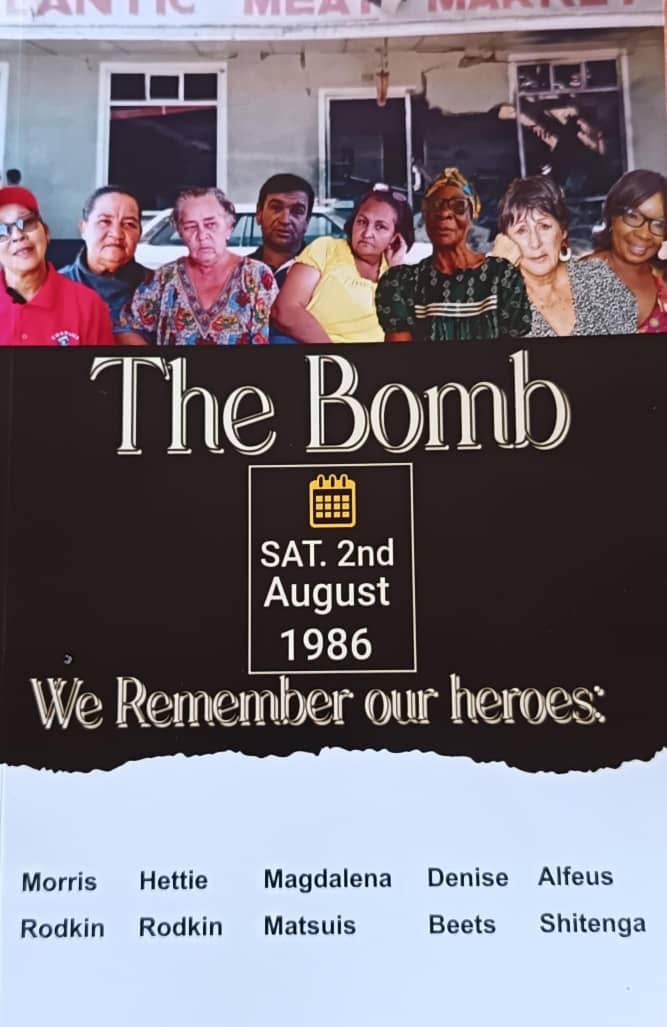
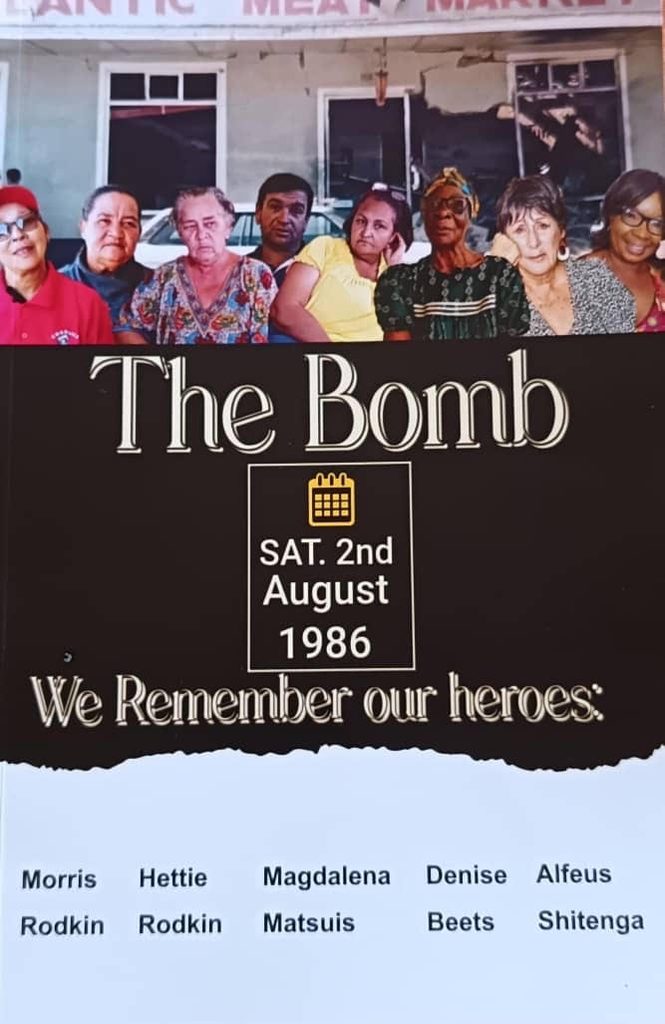
Forty years after the Atlantic Meat Market bombing shook Walvis Bay, Taati Niilenge has put the memories, experiences and stories of those who lived through that day between the covers of a book, hoping that a painful chapter in the town’s history will never be forgotten. Her book, The Bomb – We Remember, comes in a year that marks four decades since the explosion on 2 August 1986, an incident that claimed lives and left deep emotional scars on the community.
For Taati, however, the book is about more than simply remembering an event. It is about giving survivors and families of those who died an opportunity to have their stories heard, while ensuring that younger generations understand a part of Walvis Bay’s history that many have never been told. Taati personally wrote the book, drawing on testimonies from survivors she interviewed while producing a documentary about the bombing in 2024. She also included accounts from witnesses, assistants and others whose experiences could not be accommodated in the documentary. “The documentary had limited space, and I could not include more people,” she explained.
The idea for the book came after the documentary was screened and a remembrance plaque was installed on the wall of the now Charlie’s Meat Market. Residents continued contacting her, asking why the events could not also be recorded in a book. Many felt that a publication would make the accounts more accessible, particularly for people who prefer reading and for younger residents who know little about what happened. Family members and friends were especially concerned that memories of the day were slowly disappearing. Taati said the incident affected an entire community, and there was a need to ensure that the experiences of those who were there were preserved for future generations. Her own connection to the history of Walvis Bay goes back to her childhood. She remembers sitting with her grandparents and other community members as they shared stories about the town and its past. Although she was very young, those stories stayed with her. She also remembers shopping at the meat market with her grandmother, where children would often receive a free Vienna sausage. “Every time I walked past it, I remembered the story,” she said.
Over the years, she also heard older residents questioning why the Atlantic Meat Market bombing was not commemorated in the same way as other bomb incidents in the country. This eventually motivated her to produce the documentary in 2024, as a way of honouring those who lost their lives and bringing comfort to their families and friends. Putting the book together was not without its challenges. Taati began documenting the events in June, finding time to write during what she described as a very busy and challenging year. The people whose accounts she wanted to include were scattered across Namibia and South Africa, as some had since moved away from Walvis Bay. She had to track people down and, in some cases, allow family members and friends time to talk about what had happened. She said the incident had left a deep scar in the community, with residents still remembering the day vividly.
The book includes accounts from survivors, family members, assistants and friends. Some contributions are detailed personal testimonies, while others are shorter accounts describing where people were when they heard the explosion. For Taati, every story was important. “All the stories stood out for me. They were all so unique and emotional,” she said. One of the most memorable moments for her was the screening of the documentary at the Walvis Bay Community Church, sponsored by then mayor Trevino Forbes. Survivors and witnesses who had not necessarily seen one another for years came together to watch their experiences being shared on the big screen. There were tears, hugs and laughter, and a sense of belonging among those who had lived through the same traumatic experience. They were also treated to a meal at the Blue Whale Hotel and later attended the Walvis Bay mayoral dinner.
The mayoral fund itself was established following the bombing. Taati said survivors were particularly excited to finally have an opportunity to tell their stories. Many feared that they would eventually be forgotten. One survivor, Vera, continues to share her experience at her church every year on 2 August, giving thanks for having survived. Following the documentary screening, people continued asking Taati when the book would be ready. She said there was considerable excitement when she announced on Monday that it had finally been completed. For her, one of the most important reasons for putting the stories into print is the younger generation. She recalled how young people who attended the documentary screening were shocked to learn that such an incident had happened in their own town. They had many questions, as some had never heard about the bombing before.

A learner from Duinesig Combined School, Grace Pelekelo, who also narrated the story in the documentary, was among those surprised by what she learnt. Taati believes that if older generations do not share these experiences, young people will miss out on an important part of their history. She drew a comparison with her previous book, Walvis Bay: Our Story, which documents the early lives and experiences of residents. She said young people sometimes stop her in the street to tell her how much they have learnt from the book, with some previously believing that Kuisebmond and Narraville had always developed in the areas where they are situated today. “They were eager to learn more,” she said. Taati acknowledges that revisiting the bombing may bring back painful memories for some people, while others may question whether the publication has a political motivation. She does not deny that the accounts may touch old wounds, but believes that allowing survivors and families to speak about their experiences can also bring a sense of closure and comfort. Many felt that they had been forgotten or ignored for years.
The documentary and now the book have given them an opportunity to feel remembered. “Yes, the event occurred during the colonial era. Many things happened. We do not know the full story, but what we know is that it happened, and it wounded a town. Residents of different ethnicities died. But our focus in this book is to remember, and to be remembered,” she said. The Bomb – We Remember also documents the names and stories of those who lost their lives, as well as the long-term physical and emotional impact the incident had on survivors and their families. The publication includes sections for prayers for victims and survivors, as well as accounts of events that followed the documentary screening, including the unveiling of the remembrance plaque at the wall of the now Charlie’s Meat Market.
Importantly, Taati has also left blank pages in the book where other survivors, witnesses and family members can record their own experiences and contribute to the historical record. She said she initially printed only a small number of copies to establish the level of interest, with further copies to be printed as orders come in. Her hope is that the book will eventually find its way into schools and become part of history lessons, ensuring that children who were not yet born when the bombing happened will still know about it.
For Taati, the legacy of The Bomb – We Remember is simple: the stories must live on, the people who lost their lives must be remembered, and those who survived must know that their experiences matter. People interested in ordering a copy of The Bomb – We Remember can contact Taati Niilenge on 081 249 1161.
By Eileen van der Schyff