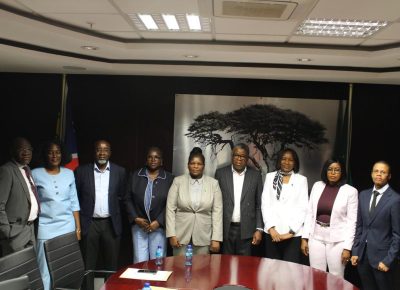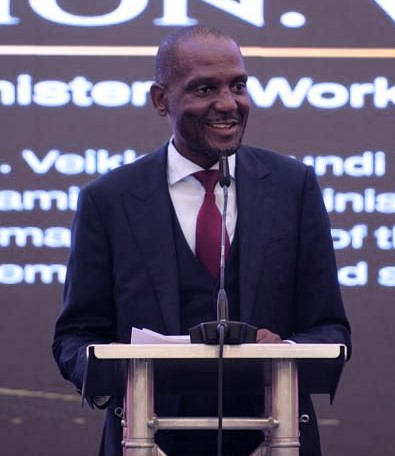
Minister of Works and Transport, Honourable Veikko Nekundi, has called for urgent reforms in Namibia’s engineering sector, warning that delays in graduate registration, soaring consultancy costs and ageing infrastructure threaten the country’s development ambitions.
Speaking at the inaugural Namibia Engineering Excellence Awards 2026, Nekundi said engineering remains one of the most critical pillars of national development, underpinning sectors such as energy, mining, agriculture, manufacturing, telecommunications, healthcare, housing, transport and environmental management. He commended the Namibia Engineering Excellence Awards Task Force and its partners for creating a national platform that recognises excellence, innovation and service within the profession. Nekundi stressed that Namibia faces a three-fold challenge: maintaining and optimising existing infrastructure, developing new infrastructure to meet growing demands, and preparing engineering systems and professionals for a rapidly changing world. “We must undertake all three responsibilities within the realities of limited financial resources, competing national priorities and increasing demands for public services,” he said.
According to the minister, the task cannot be achieved through engineering expertise or funding alone. He said effective policies, strong institutions, professional competence, innovation and collaboration across sectors are equally essential. One of the strongest concerns raised during his address was the delay faced by many engineering graduates in obtaining professional registration. Nekundi said some graduates, particularly those from previously disadvantaged backgrounds, have been unable to register for periods ranging from five to ten years after completing their studies.
Describing the situation as serious, he warned that government is closely monitoring the issue and may be compelled to amend the Engineering Council of Namibia (ECN) Act should the matter remain unresolved. Nekundi also criticised the high costs associated with engineering consultancy services, arguing that government is increasingly unable to sustain the financial burden. He revealed that he had recently been presented with road project proposals costing more than N$12 million for a five-kilometre road and N$16 million for a ten-kilometre road. The minister urged engineering professionals to reassess their pricing structures, saying government could no longer afford excessive consultancy costs.

Turning to infrastructure management, Nekundi noted that Namibia’s roads, water systems, energy networks and public facilities represent significant national investments accumulated over decades. However, he cautioned that infrastructure loses value when maintenance is neglected. He pointed to the Roads Authority’s challenge of maintaining Namibia’s approximately 50,000-kilometre road network, including sections that have exceeded their intended lifespan, as an example of a broader national issue. “Our objective must be to obtain the greatest possible service, reliability and economic value from every infrastructure investment,” he said. The minister said this principle aligns with the Ministry of Works and Transport’s Strategic Plan for 2025/26 to 2029/30, which prioritises asset management, institutional performance, regulatory compliance and improved service delivery.
Concluding his remarks, Nekundi called on engineers, policymakers and stakeholders to work together in safeguarding Namibia’s infrastructure and driving sustainable development. “Let us preserve wisely, build responsibly, innovate purposefully and work together to ensure that engineering continues to serve Namibia’s national development,” he said.
By Rudi Bowe