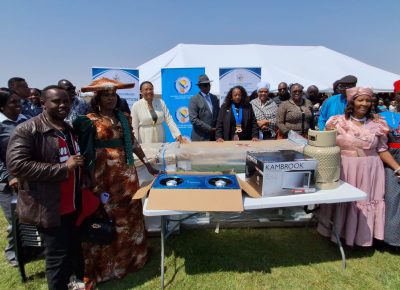
Government officials, law enforcement agencies and community members gathered in Henties Bay last week (Wednesday) to commemorate the World Day Against Trafficking in Persons, using the occasion to warn the public about the growing threat of online scams and fake job offers used to lure victims into human trafficking.
This year’s commemoration was held under the global theme “Trapped Behind the Scam”, which highlights the increasing link between human trafficking, cybercrime and organised criminal networks. Delivering a speech on behalf of Erongo Governor Natalia /Goagoses, the Chairperson of Erongo Regional Council Lazarus Kanelombe said human trafficking remains one of the world’s fastest-growing organised crimes, with traffickers increasingly using fraudulent employment opportunities, dating applications and social media to recruit victims.
“The Namibian youth are being enticed into online scams promising employment abroad,” he said, adding that unemployment, poverty and inequality continue to make many young people vulnerable to traffickers. Kanelombe said Namibian Police statistics show that 10 new trafficking cases were reported between March 2025 and April 2026, compared to six cases during the previous reporting period. The cases included Namibians trafficked to Myanmar, while victims from Zambia and Angola were trafficked into Namibia. He said Namibia continues strengthening its response through the Combating of Trafficking in Persons Act, Act 1 of 2018, the National Action Plan on Combating Trafficking in Persons (2023–2027), specialised police units and increased public awareness campaigns.
Addressing the gathering on behalf of the Acting Inspector General of the Namibian Police, Major General Anna-Marie Nainda, Senior Inspector Judith Shomongula warned that traffickers are becoming increasingly sophisticated by using fake employment opportunities, fraudulent scholarships, sham travel arrangements and online romance scams to deceive victims. She said the Namibian Police had previously dismantled an international online scam syndicate that recruited unemployed Namibian youth and forced them to participate in online fraud operations after luring them with false job offers.
The investigation involved cooperation with several international partners, including Interpol and authorities in the United States, Belgium, Canada and the United Kingdom. Shomongula said police, working with various government ministries, had also received 16 Namibians returning from Myanmar, Laos, Thailand and Cambodia between April 2025 and June 2026 after they had become victims of trafficking linked to scam compounds. Focusing on the regional picture, she said Erongo recorded 13 trafficking in persons cases between 2010 and 2024. Most were initially reported as rape before investigations revealed elements of human trafficking.
According to Shomongula, the cases involved sexual exploitation, labour exploitation and immigration-related offences, with six foreign nationals among those charged alongside Namibian accomplices. Three of the cases involved four Namibian women who acted as recruiters. She said no new trafficking cases have been reported in Erongo since January 2025, while 11 offenders have been convicted and sentenced to prison terms ranging from 15 to 35 years. Despite this progress, she cautioned that trafficking remains a hidden and underreported crime and urged communities to remain vigilant and report suspicious activities.
Medical Practitioner Dr Matheo de Villiers delivered an emotional address centred on the concept of “autonomy”, describing it as every person’s right to decide what happens to their own body. He said human trafficking, like rape and child abuse, strips victims of that fundamental right. “No one has the right to take away your autonomy. No one has the right to force you into something which you do not want to go into,” he said.
De Villiers called on parents, families and communities to play a more active role in protecting children and young people from exploitation, urging adults to take reports of abuse seriously and ensure they are properly investigated. Speakers throughout the event stressed that combating human trafficking requires a coordinated effort from government, law enforcement, civil society and communities. Members of the public were encouraged to report suspected trafficking to the Namibian Police on the toll-free number 1011 or the Gender-Based Violence helpline on 106.
By Sharlien Tjambari