A preliminary report released by the Ministry of Works and Transport’s Directorate of Aircraft Accident and Incident Investigations (DAAII) has shed light on the circumstances surrounding a fatal light aircraft crash near Gobabeb earlier this year.
The accident occurred on 4 March 2026, when a United Kingdom-registered Groppo Trail aircraft, registration G-SMLI, was involved in a collision with terrain shortly after take-off from the Gobabeb airstrip. According to the report, the aircraft departed at approximately 17:00 local time on a private flight, conducting an aerial wildlife observation mission in the surrounding area.
There were two occupants on board, the pilot and one passenger. Concern was raised when the aircraft failed to return after an extended period and no communication was received. A ground-based engineer, part of a three-person team at the research facility, initiated a search.
The wreckage was located at around 21:00, approximately two kilometres from a nearby residential settlement and just short of the runway. Emergency services and aviation authorities were subsequently alerted, and investigators arrived on site the following morning to begin their assessment. Both occupants sustained fatal injuries in the crash.

The pilot, a 62-year-old male, held a valid Airline Transport Pi-lot Licence (ATPL) issued by the aircraft’s state of registry, along with multiple ratings, including single- and multi-engine piston aircraft, touring motor glider, and flight instructor certification. He was also operating under a Foreign Licence Validation Certificate issued by Namibian authorities, which permitted private day visual flight operations and remained valid at the time of the accident.
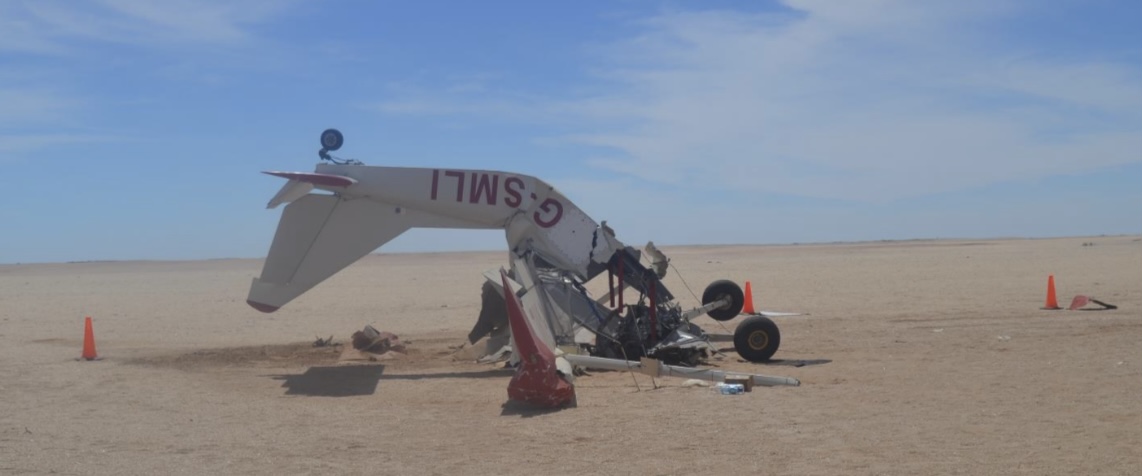
The aircraft itself was a two-seat, high-wing, single-engine light aircraft operating under a Permit to Fly framework for amateur-built aircraft. It had a valid Certificate of Validation for a special flight period between 25 February and 6 March 2026. Investigators reported that the wreckage was found on flat desert terrain in a relatively compact area. The forward section of the aircraft, including the cockpit, sustained severe structural damage, with significant crushing that eliminated any survivable space. While the wings remained attached, they showed extensive deformation, and parts of the fuselage were heavily disrupted. The rear section of the aircraft remained comparatively intact. Initial findings confirm that both the pilot’s documentation and the aircraft’s certification were valid at the time of the flight.
The Directorate emphasised that the report is preliminary and aim-ed solely at promoting aviation safety, not assigning blame or liability. Further investigations are ongoing, including the collection and analysis of additional data. A final report will be issued once the investigation is complete.
By Eileen van der Schyff