- Conservation concerns and economic analysis highlight questions about environmental preparedness and the potential long-term benefits of petroleum development
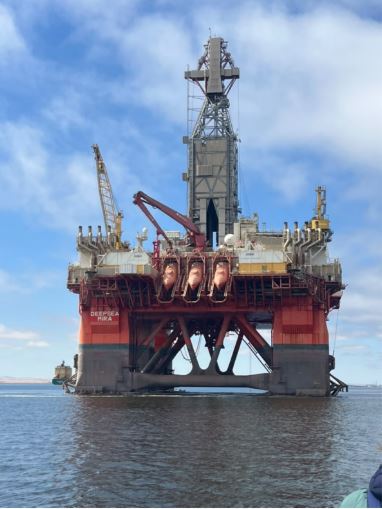
The semi-submersible drilling rig Deepsea Mira anchored in Walvis Bay (Photo: Rhythm Stewart)
Namibia’s offshore oil and gas discoveries have raised expectations of economic growth, investment, jobs and increased government revenue. However, questions are also being raised about the possible environmental impact of these developments and how much the country could ultimately benefit. As interest in the country’s offshore resources grows, conservation organisations and researchers are calling for careful planning, reliable scientific information and greater public discussion.
The debate was among the issues discussed at the Namibia Oil and Gas Conference and Exhibition (NOGC2026), held in Windhoek from 18 to 20 August, as well as a regional workshop hosted by WILDTRUST on 25 August. The discussions highlighted the need to consider both the economic opportunities and the possible environmental and social consequences of offshore petroleum development.
Damian Schreiber of Ocean Conservation Namibia (OCN) has raised concerns about whether the country’s environmental protection systems and marine conservation capacity are keeping pace with the rapid interest in offshore oil and gas development. Schreiber believes that while the potential economic opportunities are important, environmental protection should remain a central part of the discussion. Offshore activities can involve seismic surveys, drilling, production and the movement of vessels and equipment. These activities require careful environmental planning and monitoring. Oil spills are another concern associated with offshore petroleum operations. Although the likelihood and possible consequences of an incident depend on several factors, preparedness and the ability to respond effectively are important considerations for any country developing offshore resources. Schreiber has also highlighted the importance of ensuring that conservation organisations, marine scientists and other relevant stakeholders are included in discussions about the future of Namibia’s marine environment.
A week after the NOGC2026 conference, WILDTRUST hosted a regional workshop bringing together representatives from conservation organisations in Namibia, South Africa and Mozambique. The workshop focused on the potential environmental risks associated with offshore oil and gas development and the importance of cooperation between countries. According to the workshop report, participants discussed the need for independent scientific research, improved access to environmental information, meaningful public participation and stronger regional cooperation. One of the issues raised was the need for independent oil-spill modelling to help improve understanding of possible risks and inform emergency planning. The report also records discussions about the importance of sharing information and strengthening the ability of organisations and authorities to respond to possible environmental incidents. These discussions reflect concerns raised by conservation stakeholders. They do not, however, establish that an environmental breach has taken place or that a particular incident will occur.
Namibia’s marine environment is part of a wider regional system. The Benguela Current flows northwards along the southern African west coast, making scientific research and regional cooperation important when considering potential environmental risks. Environmental concerns are only one part of the debate. The potential financial benefits of offshore oil and gas development are also receiving attention.
In September 2026, Recourse published a study titled Gas Is Bad Economics for Namibia, examining the possible economic implications of offshore oil and gas development. The study was written by Charles Lawrie, with input from The Green Connection, Power Shift Africa and Africa Change Lab. The study questions whether projected economic growth from petroleum development will necessarily translate into substantial and timely benefits for the Namibian public.
In written responses to questions from Namib Times, Rajneesh Bhunee of Recourse clarified that the study does not claim Namibia will receive no economic benefit from oil and gas projects. Rather, its central concern is how much revenue Namibia could retain, when that revenue might become available and how much control the country would have over the development of the resources. Bhunee explained that large projected economic figures do not automatically show how much money will reach government or benefit the wider population. He said the final outcome would depend on factors such as production levels, oil and gas prices, development costs and the fiscal arrangements agreed between government and companies.

One of the issues discussed in the Recourse study is the way petroleum projects recover their costs. Under arrangements where companies recover eligible development costs before profit oil is shared with the state, government revenue may take time to materialise. Bhunee said this means the timing and amount of revenue received by Namibia can be affected by the costs of developing a project and the conditions under which it operates. He stressed that the study does not suggest that Namibia cannot benefit, but argues that the potential benefits should be assessed realistically and not based only on headline projections. The study also raises questions about the risks of relying too heavily on one sector, particularly when oil and gas projects involve large investments and can take many years to develop.
For Namibia, the challenge will be to ensure that any future revenue contributes to long-term national development and benefits the wider population. Another issue raised in the Recourse study is whether offshore gas development will automatically improve Namibia’s access to electricity. Bhunee explained that the study mainly examines offshore oil and gas projects intended for export. It does not assess all possible future arrangements for supplying gas to the domestic market. He said using offshore gas locally would require appropriate infrastructure, including facilities to process, transport and distribute the gas, as well as infrastructure to generate electricity where applicable.
These developments would involve additional investment and decisions about who would carry the costs and financial risks. The distinction is important because the discovery of gas does not, on its own, mean that households and businesses will have access to cheaper or more reliable electricity. The study encourages policymakers to consider the costs and risks of different energy options, including investment in renewable energy and domestic electricity infrastructure. The potential creation of jobs is often mentioned as one of the expected benefits of offshore oil and gas development. However, the Recourse study raises questions about the extent to which a capital-intensive industry can provide employment across the wider economy. Offshore petroleum projects require specialised skills, equipment and significant investment. While they may create opportunities in areas such as engineering, logistics, services and support industries, the number and type of jobs will depend on the projects that are developed and the skills available locally.
For Namibia, an important consideration will be how local businesses and workers can participate in the industry and whether the economic benefits can support development beyond the petroleum sector. Both the conservation discussions and the economic study point to the importance of reliable information when decisions about offshore development are made. Environmental research can help authorities and the public better understand possible risks to marine ecosystems. Economic analysis can help assess the likely costs, benefits and financial risks of projects. The Recourse study also acknowledges limitations in its own research. Bhunee said it is a desk-based study and does not provide a detailed model of the government revenue expected from each individual offshore project. He explained that actual outcomes will depend on project-specific information and agreements, some of which may still be under discussion. This is an important distinction when considering projections about the future of Namibia’s oil and gas sector. Estimates and forecasts should not be confused with confirmed revenue or guaranteed benefits.
For this article, Namib Times approached Ocean Conservation Namibia, the Ministry of Environment, Forestry and Tourism, the Ministry of Industries, Mines and Energy, and WILDTRUST for comment on the issues raised. Damian Schreiber of Ocean Conservation Namibia provided comments on the conservation concerns surrounding offshore development. Rajneesh Bhunee of Recourse also responded in writing to questions about the economic findings of the September study. The other organisations approached were given an opportunity to respond, and additional time was allowed for comment. However, no responses had been received by the time of publication.
Namibia’s offshore discoveries could open the door to significant investment and economic opportunities. At the same time, the country faces important decisions about environmental protection, energy planning, public participation and the management of future revenue. The discussions surrounding offshore development show that the issue is not simply about whether oil and gas can bring economic benefits. It is also about how those benefits are measured, who receives them, what risks are involved and how Namibia protects its marine environment.
By Eileen van der Schyff