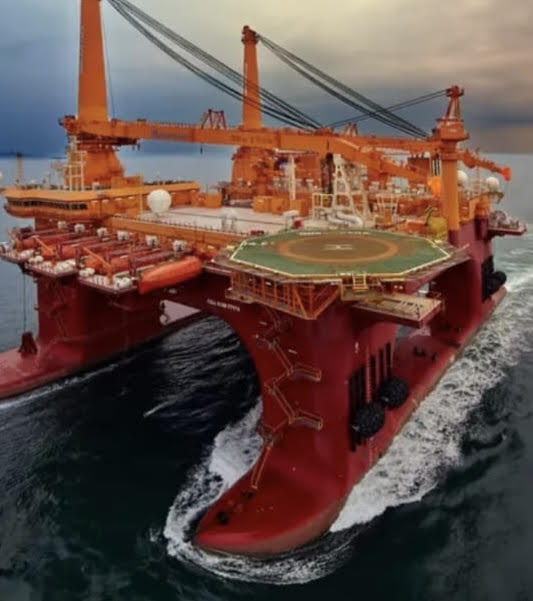
A massive offshore construction vessel has drawn attention after being observed in the waters near Pelican Point, with maritime tracking data identifying the unit as the semi-submersible crane vessel Blue Gretha (IMO 9650963).
The vessel, a large multi-functional offshore construction and accommodation platform, is currently anchored or operating offshore within the Walvis Bay maritime area, sparking local curiosity due to its size and industrial appearance.
The Blue Gretha is a semi-submersible crane vessel (SSCV) and offshore accommodation unit built in 2012. It sails under the Marshall Islands flag and is designed for heavy offshore construction and maintenance operations. Key specifications include – Length: approximately 137 metres; Beam: approximately 81 metres; Two 1 800-tonne Huisman cranes; Tandem lifting capacity of up to 3 600 tonnes; Accommodation capacity for up to 618 personnel; Primary function: offshore construction, maintenance support, and accommodation (floatel).
The vessel has previously been known under different names, including OOS Gretha and Huadian Zhongji 01, following refurbishment work carried out at a shipyard in China.

According to publicly available maritime and offshore industry sources, the vessel has been linked in past reporting to large-scale offshore energy projects, including support and accommodation operations for deepwater developments. Industry publication Offshore energy has re-ported that vessels of this class, including the Blue Gretha, are typically deployed for: offshore platform installation and maintenance; heavy lift operations; accommodation for offshore construction crews; deep-water oil and gas project support.
The vessel has also been reported in offshore industry tracking to have been associated with operations connected to large energy infrastructure projects in West Africa, including deepwater developments. However, the specific reason for its current presence near Pelican Point has not been officially confirmed at the time of publication. Maritime monitoring platforms list the vessel as active and operational, with live position tracking available through global ship tracking systems such as Marine traffic and Vessel-finder.
These systems provide vessel type classification, historical routes, and current AIS (Automatic Identification System) data used in commercial shipping and offshore monitoring. While no official confirmation has been issued, vessels of this type typically enter coastal waters for: offshore project staging or transit; supply or crew transfer operations; sheltered standby positioning; logistical coordination near port infrastructure. Given its capabilities as both a crane vessel and accommodation platform, the Blue Gretha is capable of supporting complex offshore engineering operations in deep-water environments. The size and industrial nature of the vessel have made it highly visible from coastal viewpoints, particularly around Pelican Point, where large offshore ships are often seen entering or exiting Walvis Bay harbour.
By Eileen van der Schyff