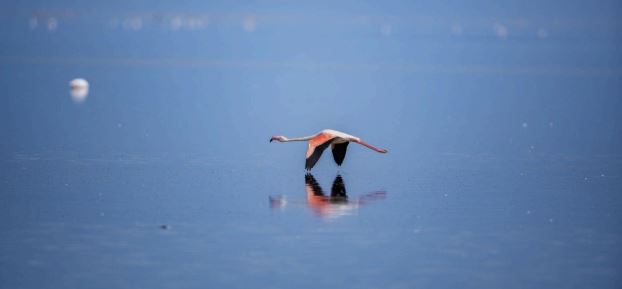
Photo: Our Walvis Bay flamingos attract visitors from all over the world (Photo by Rig & Studio)
More than 87 000 birds were recorded during this year’s Walvis Bay Wetland Winter Bird Count, with flamingos making up more than half of the total.
According to Damian Schreiber, Publicist, Educator, Seal Rescuer and Junior Researcher at Ocean Conservation Namibia, the annual count provides an important picture of the birdlife using the Walvis Bay Lagoon and surrounding wetlands. “The winter count is one part of a bigger picture,” Schreiber explained. “We also have a summer count, and by looking at the numbers from both periods over many years, we can get a better understanding of the health of the wetland and how bird populations are changing.”
The winter count took place over two days, with conservationists, bird enthusiasts and students working in teams to survey the lagoon and Walvis Bay Salt Works. The teams recorded every bird and species they encountered. This year’s winter total of just over 87 000 birds is significantly higher than the 33 000 recorded in August last year, but above the 74 500 counted in 2024. The highest winter count recorded at Walvis Bay was in 1992, when about 114 000 birds were counted. Of this year’s 87 000-plus birds, around 51 000 were flamingos. Schreiber said the difference between the summer and winter numbers is largely linked to seasonal movements.
The summer count earlier this year recorded almost 90 000 birds in total, but only around 5 500 were flamingos. “This is where the seasonal movement of the flamingos becomes interesting,” he said. According to Schreiber, good rainfall inland can have a major effect on where flamingos are found at different times of the year. Rainfall this year filled areas such as Etosha Pan in Namibia and the Sua Pan in Botswana. Flamingos are intra-African migrants and move between different wetland habitats across the continent. When inland pans have enough water, flamingos can move there to feed and breed.
During the winter months, many return to coastal wetlands such as the Walvis Bay Lagoon, where they find rich feeding grounds. For Schreiber, the annual counts are also about much more than simply knowing how many birds are in the area. The project relies heavily on citizen science, with volunteers helping to collect scientific data across a large area. “It is a good example of how ordinary people can contribute to scientific research,” Schreiber said. “You don’t necessarily have to be a scientist to take part.” The information collected over many years can help researchers identify changes in bird numbers and understand what may be happening within the wetland ecosystem. Walvis Bay’s birdlife also has an important role to play in tourism and the local economy. The lagoon attracts birdwatchers and visitors, while the large numbers of birds make the area a significant destination for nature-based tourism.
Schreiber pointed out that many of the birds seen around Walvis Bay are not resident birds. Some travel from other parts of Africa, while tens of thousands of migratory birds make the long journey from areas such as Siberia and Northern Europe. The Walvis Bay Lagoon therefore serves as an important stop where these birds can rest and feed before continuing their migration. The winter and summer bird counts are supported by the Walvis Bay Salt Company, the University of Namibia and the Ministry of Environment, Forestry and Tourism.
Schreiber said members of the public are welcome to become involved in future counts, and no previous experience is required. Anyone interested in taking part can contact John Paterson at cbirdsrule@gmail.com.
By Eileen van der Schyff