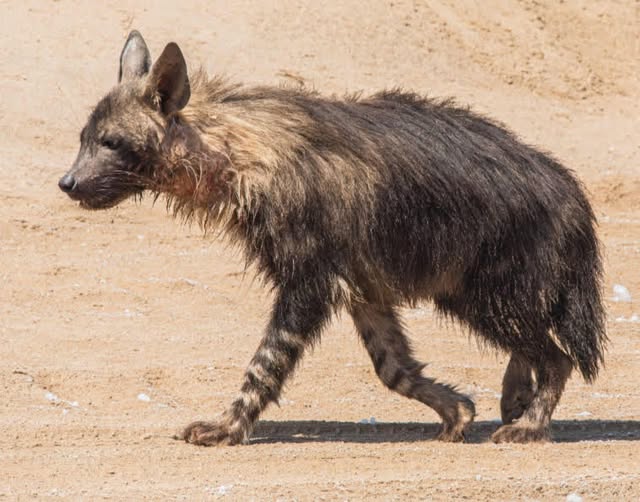
Photo: Brown hyenas are secretive scavengers (Photo: Arno Theron)
Often unseen and misunderstood, the four-legged scavengers of Namibia’s coastline are emerging as vital players in maintaining the fragile balance between ocean and desert ecosystems.
According to Damian Schreiber, Field and Research Officer at Ocean Conservation Namibia, species such as the brown hyena and black-backed jackal are indispensable to coastal health, despite often being overlooked by visitors. Speaking on insights gathered from multiple conservation and research platforms, Schreiber described these animals as the coastline’s “beach cleaners,” uniquely adapted to survive in one of the harshest environments on Earth. “People come to the coast for the seals and the scenery, but they miss the silent workers,” he said. “These scavengers are what keep the system functioning.” While jackals are a common sight along Namibia’s shoreline, the elusive brown hyena—locally known as the “Strandloper” is far rarer.
Namibia is home to an estimated 800 to 1 200 brown hyenas, with roughly half found along the coast where they rely heavily on marine food sources. “These animals survive largely off what the ocean provides, washed-up seabirds and seal carcasses,” Schreiber explained. “However, recent observations have revealed a surprising shift in behaviour. While hyenas have long been known to prey on seal pups, researchers have, since mid-2025, documented instances of brown hyenas successfully hunting adult Cape fur seal. It’s extraordinary,” Schreiber noted. “You’re looking at a 45-kilogram hyena taking down a seal that can weigh over 100 kilograms, sometimes even 300. That changes how we understand their role in the ecosystem.” The brown hyena’s primary competitor along the coast is the black-backed jackal, whose population density can fluctuate dramatically. While numbers can be as low as 0.1 per km, they surge near seal colonies, particularly after pupping season, reaching up to 76 per km. This proximity to seal populations has also raised concern among scientists. “Jackals are known carriers of rabies, and there is growing evidence suggesting they may have triggered a rabies outbreak among Cape fur seals,” Schreiber said. The suspected transmission chain began with a jackal bite in Namibia, spreading to seal colonies in South Africa in 2024, before returning to Namibia in 2025 through seal-to-seal transmission. “This kind of cross-species infection shows just how interconnected and vulnerable the system is,” he added. Despite the risks, both species play a critical ecological role. By scavenging carcasses, they help prevent disease outbreaks and facilitate the transfer of nutrients from the ocean back into the desert environment. “These animals are essential recyclers,” said Schreiber. “Without them, the coastline would face serious ecological consequences.” Ongoing research efforts, including studies by the Brown Hyena Research Project and independent researchers such as Emsie Verwey, continue to shed light on these elusive animals. However, Schreiber emphasised that more attention needs to be given to the black-backed jackal, particularly considering its role in disease transmission.
Drawing from information sourced through conservation platforms including Wilderness Safaris, Strandwolf, Gondwana Collection, the Namib Conservation Ecology initiative, and regional research publications, Schreiber stressed the importance of public awareness. “In a place as extreme as Namibia’s coast, survival depends on balance,” he said. “And sometimes, it’s the animals we don’t notice that matter the most.”

By Eileen van der Schyff