Higher fuel prices and a drop in diamond production put pressure on the industry

Namibia’s mining sector is facing rising operating costs and lower production, although strong prices for some minerals and planned mining projects offer hope for the future. According to the Chamber of Mines of Namibia’s September 2026 Monthly Mining Update, the country’s mining production index fell by 4% in August, mainly because diamond production dropped by 12%.
The report also highlights the impact of rising fuel prices and inflation on mining operations, as higher costs put pressure on mines already struggling with lower profits. For Namibia, where mining contributes significantly to export earnings, these developments are important for the wider economy. The ongoing war in the Middle East continues to push up global energy prices. Brent crude oil averaged USD116.80 per barrel in September, an increase of 28.5% from August. In Namibia, annual inflation increased from 5% in August to 5.4% in September. Transport inflation reached 14.9%, while petrol and diesel prices rose by 30.4% over the same period.
The Chamber of Mines says higher fuel and diesel prices are increasing operating costs across the mining sector and reducing profit margins. Higher inflation could also lead to further interest rate increases, which may slow economic activity and weaken demand for some minerals. Mineral prices showed mixed results in September. The average gold price fell by 2% from August to USD4 319 per troy ounce, while tin prices dropped by 3% to USD53,712 per tonne. Copper increased by 1% to USD14 474 per tonne, while zinc rose by 4% to USD4 021 per tonne. Uranium prices also increased by 2%, reaching USD89.79 per pound.
Despite the monthly declines in gold and tin prices, their average prices remained higher than a year earlier. Gold was up 18% year on year, while tin was up 56%. Uranium was 15% higher year on year, while copper had increased by 45%. The report notes that higher inflation and interest rates could limit further price increases, although the longer-term outlook for minerals such as gold, uranium and copper remains positive. The 4% monthly decline in Namibia’s mining production index was mainly driven by a 12% drop in diamond production. Production of uranium increased by 8%, zinc by 27% and gold by 4% over the same period. However, these gains were not enough to offset the decline in diamond production.

The report indicates that overall mining output in 2026 is likely to remain under pressure, based on production trends recorded so far this year. The Bank of Namibia has revised its forecast for the mining sector in 2026, now projecting a contraction of 6.2%, compared with the previously expected contraction of 2.2%. Despite the pressure on production, mineral exports made up a larger share of Namibia’s domestic exports in August. The country recorded domestic exports worth N$9.33 billion, of which mineral-related exports accounted for N$6.69 billion. This represented 72% of domestic exports, up from 62% in July. Uranium was the main contributor to the increase, with exports rising by 438% from July to N$3.36 billion in August.
According to the report, this followed the resumption of full production at the Husab mine in July after a planned 22-day plant maintenance shutdown in June. Gold exports fell by 21% to N$1.51 billion, while diamond exports increased by 5% to N$1.46 billion. Despite the challenges facing the sector, the Chamber of Mines says Namibia’s medium- to long-term mining outlook remains positive. Several projects and expansions are expected to support future production, including Bannerman’s Etango Uranium Project, Reptile Uranium’s Tumas Uranium Project and Osino Resources’ Twin Hills Gold Project, which is expected to begin production in the second half of 2027. The planned ramp-up of the Langer Heinrich uranium mine and the Rosh Pinah RP2.0 expansion project are also expected to contribute to future output.
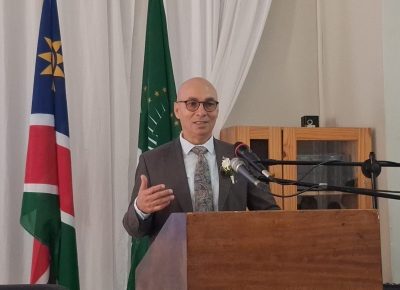
The Chamber of Mines believes that higher average gold and uranium prices could help offset lower production volumes in the short term, supporting export earnings and government revenue. “Near-term cost and macroeconomic pressures are real, but firm gold and uranium prices and a strong project pipeline keep the outlook for Namibia’s mining sector positive,” said Fabian Shaanika, chief executive officer of the Chamber of Mines of Namibia.
By Eileen van der Schyff